Småland
The EmigrantsSmåland is the home landscape from which the emigrants in The Emigrants depart, and the novel’s essential counterweight to the uncertain promise of North America. Its farms, family customs, and seasonal rhythms have sustained generations, yet shrinking holdings and narrow prospects press younger households toward departure. The province is therefore neither a mere backdrop nor a simple home to be rejected: it is the material world that has formed the emigrants, the place they must leave, and the measure by which they imagine what another land might offer.
Definition and Agrarian Setting
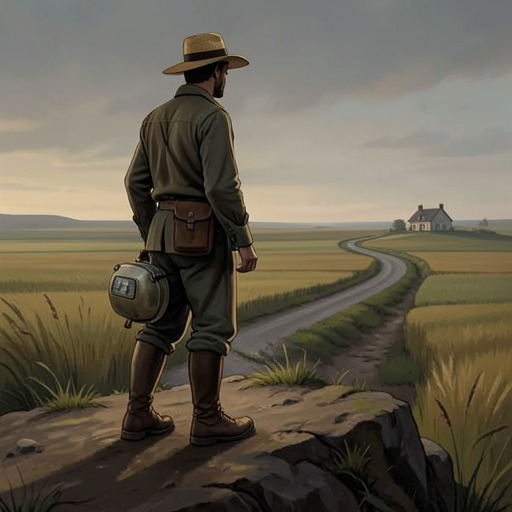
In the novel’s introduction, the emigrants come from Ljuder Parish in Småland, where people have tilled the same ground for thousands of years. Small cottages shelter large families; sons succeed fathers at the plow and harrow, while daughters take their mothers’ places at spinning wheel and loom. Rye fields and cattle provide food, and wool, flax, and animal skins supply clothing and shoes. Much of what people need comes from the farm, leaving them dependent chiefly on the weather and the fortunes of the harvest.
The farm is presented as a world of its own, but not as a world untouched by hardship. Birth, marriage, christening, and death unfold beneath the same roof of rough-hewn pine, while everyday life follows the recurring changes of the seasons. The image is at once secure and confining: inherited practices make a household intelligible across generations, but the land remains the foundation of livelihood, and a poor harvest can endanger the whole pattern of life.
Ljuder Parish gives this regional setting a measurable scale. On January 1, 1846, it had 1,925 inhabitants, and its population had nearly tripled over the preceding century. Over the same period, the number of people outside assessed property—among them servants, cottagers, squatters, parish dependents, retired people, and those without permanent homes—had increased fivefold. The figures point to a change in the balance between people and secure holdings: the settled appearance of village life concealed a growing population with uneven access to land and livelihood.
Land Division and Livelihood
The pressure is visible in the parish’s changing farms. Forty-three full homesteads, divided among 87 owners in 1750, had become 254 independent farms by 1846 as property was further subdivided, often at deaths. Two-thirds of the resulting farms amounted to one-eighth of an original homestead or less. Only four properties still exceeded a homestead: the freeholds of Kråkesjö and Gösamåla, the parsonage, and the sheriff’s manse at Ålebäck. Inherited land remained the basis of family life, but subdivision made that inheritance progressively smaller.
Agriculture and cattle raising supplied most livelihoods; handicraft played a smaller part. The parish’s roughly 350 stills in the 1840s reveal another way households tried to make farming pay: grain prices were low enough that distilling brännvin could improve the return, and about one person in six owned a still. Production was scaled to the size of the farm, from a fifteen-gallon still on a quarter homestead to a thirty-gallon still on a half homestead. The example clarifies how closely household income, legal regulation, and the size of a holding were bound together.
This background gives the emigrants’ hopes and disagreements their material force. The group from Ljuder does not leave for a single reason: crop failure, pressure from authorities, religious dissent, personal troubles, social exclusion, and unfair employment practices all contribute to individual decisions. The province supplies a shared point of departure, not a shared motive. The group’s gathering makes the variety of local pressures visible as one historical movement, while preserving the distinct circumstances that brought each person to the road.
Home, Departure, and the Idea of America
For Karl Oskar Nilsson, the prospect of staying in Korpamoen means years of work without improvement. After four years there, he and Kristina Johansdotter are several hundred riksdaler poorer; he fears that continued labor will leave them worn down, with only a reserved room and meager bread to show for it. His comparison with his crippled father turns an economic calculation into a picture of the future: remaining in Småland threatens to reproduce the older generation’s exhaustion rather than secure a better life for the children.
Kristina’s hesitation gives the home landscape a different weight. She distrusts accounts of North America because neither a deed nor a personal guarantee promises them land, and she has never met anyone who has seen the country. For her, the familiar home and its risks are more knowable than a destination described only in books and newspapers. Their disagreement is not simply courage against fear: Karl Oskar weighs the visible failure of the present against a chance elsewhere, while Kristina asks what evidence can make that chance trustworthy.
The practical arrangements show how a wish to leave becomes a journey. Karl Oskar and Robert Nilsson arrange passage on the Charlotta through a firm in Karlshamn, paying a hundred daler down for six places; the group intends to sail directly to New York in early spring, in time to plant and later harvest in its new home. When Danjel Andreasson considers joining, Robert is to seek a contract for him if the ship has room. The migration takes shape through linked household decisions, information, money, a vessel, and other people’s participation—not through hope alone.
Selling Korpamoen reveals the cost of making that movement possible. The buyer’s leverage forces Karl Oskar to accept one hundred and fifty daler less than he paid for the farm. The cattle bring better prices amid scarcity after the famine-year slaughter, but the auctioneer retains a quarter of the proceeds for advancing the money. After debts and mortgage are deducted, 1,200 daler remain; passage for the family’s three adults and three children costs 675, leaving about 500 for arrival, onward travel, and the equipment and cattle needed for a farm. Kristina sews the remaining money into a sheepskin bag that Karl Oskar can fasten beside his body. The New World appears within reach, but the means of reaching it consume nearly half the household’s resources before settlement has begun.
Leaving the Province
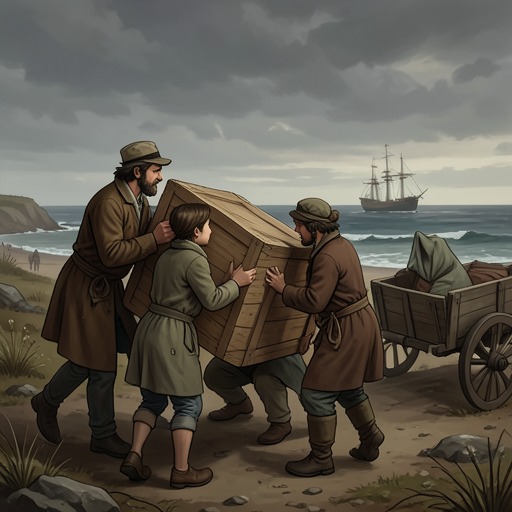
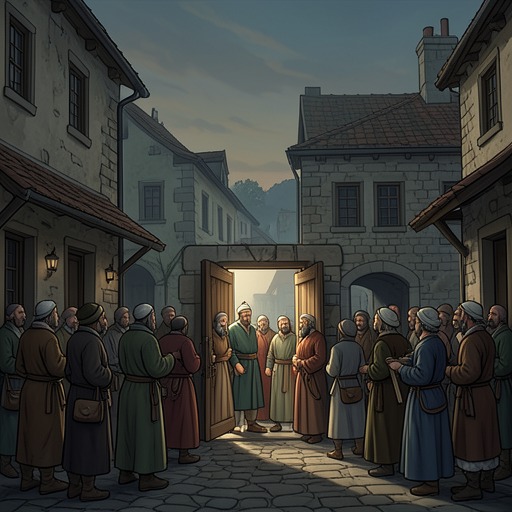
The emigrants’ departure makes clear that leaving a home is not the same as ceasing to belong to it. On the wagon road, Karl Oskar and Kristina silently mark familiar places they will see for the last time, wanting to retain the brook and meadow in memory. At Åkerby Junction the separate households meet: Danjel travels with his wife, children, and Ulrika of Västergöhl, while Jonas Petter of Hästebäck drives another wagon carrying Arvid and Elin among his passengers. The party numbers sixteen emigrants—nine adults and seven children—besides three drivers who will return from Karlshamn. What began as separate pressures has become a traveling company.
The road also alters the emigrants’ sense of the land they are leaving. After crossing into Blekinge, the travelers hear Jonas Petter describe the old antagonism between the border populations and the violence once associated with the forest route. His account of fights in the so-called snake forest binds the journey to local histories of danger and hostility. Småland is not isolated from the world around it: its people carry regional loyalties and inherited accounts with them as they pass beyond its borders.
At the last sight of Sweden, the departing voices expose the unequal meanings of home. One emigrant mourns a foreclosed farm yet insists that a farmer who falls into debt there cannot rise again; another recalls exhausting manor labor and contempt from the gentry, while a third leaves after becoming an enemy of the minister. These grievances differ, but each links departure to an authority or economic condition experienced at home. The emigrants can miss a farm, relatives, or friends without wanting to return to the country that constrained them.
Their arrival in New York sharpens the contrast rather than erasing it. After storms, illness, confinement, scurvy, and ship fever, the passengers see living green earth from the Charlotta and recover a sense of energy and possibility. The land across the ocean answers a longed-for image of fertile ground, but the voyage has shown that access to it is uncertain and costly. Småland thus remains the point of comparison behind the arrival: the emigrants leave a world of limited holdings and familiar seasons for an unfamiliar landscape, carrying both the hope of release and the memory of what they have left.